


Most surfers plateau in the same place. You can paddle out, you can stand up, and you can ride a wave that comes straight at you. What separates that from surfing well is not a secret manoeuvre but a handful of habits that intermediate surfers rarely practise on purpose. These are the five that make the biggest difference, in the order we teach them at our surf camp in Weligama.
1. Watch yourself on video
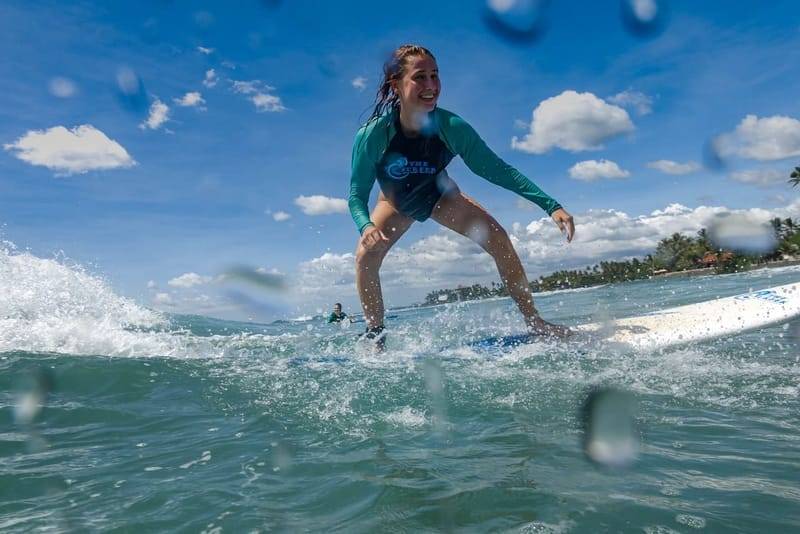
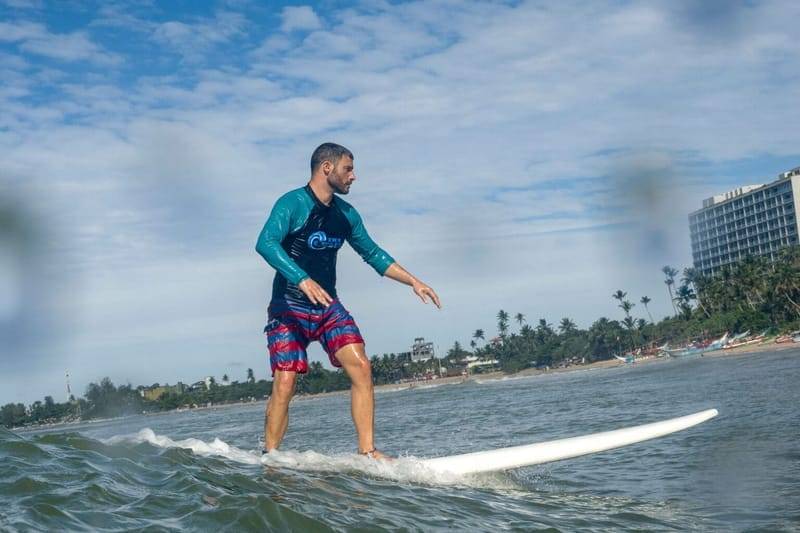
Nothing improves your surfing faster than seeing what you actually do on a wave, rather than what you think you do. Almost every surfer who watches their first clip has the same reaction: the pop-up is slower than it felt, the stance is narrower, and the eyes are pointed at the board instead of down the line.
Video analysis turns vague feedback into something you can fix. "Bend your knees more" is hard to act on. Seeing yourself stand bolt upright on three consecutive waves is not. Pick one thing per session, film again the next day, and compare. At The Surfer, video analysis is part of every weekly package, and the instructor reviews the footage with you the same afternoon, so the correction is fresh for the next morning's session.
2. Train your paddling, not just your surfing
Watch a good surfer for an hour and you will notice how little of it is spent riding waves. Most of it is paddling: out through the whitewater, back to the peak after every ride, and sideways to hold position against the current. If your paddling is weak, you arrive at the lineup tired and miss the best waves because you cannot get to them in time.
Paddle fitness is specific. Running and cycling help your lungs, but they do not build the shoulders, lats and lower back that paddling uses. Swimming is the closest match. On land, a simple routine of push-ups, pull-ups or rows, and back extensions three times a week makes a noticeable difference within a month.
3. Ride the right board for your level
Nothing holds intermediate surfers back like a board that is too small. A shortboard looks like progress, but a board with too little volume sinks on the paddle, catches fewer waves, and punishes every mistake in your timing. Fewer waves means less practice, and less practice means slower progress.
The right board for the stage you are at catches waves easily, gives you a stable platform to work on your stance, and still turns when you ask it to. For most surfers moving beyond beginner that is a funboard or a high-volume shortboard between 6'8" and 7'6", with plenty of width and thickness. Our guide on what size surfboard is right for you covers the numbers in detail.
4. Learn to read the ocean
Wave selection is the skill that separates a surfer who catches ten waves a session from one who catches three. It is about reading what the ocean is doing before it happens.
Start on the beach. Before you paddle out, watch the lineup for ten minutes. Where are the waves peaking? Which direction do they peel? How long is the gap between sets, and how many waves are in each set? All of that tells you where to sit. Once you are out there, keep watching the horizon. A darker line, a lump that grows as it approaches, a change in the texture of the water: these give you the few seconds you need to move into position rather than scramble.
Understanding swell and wind takes this a step further. Our post on reading the Sri Lanka surf forecast explains what swell period, swell direction and offshore wind mean for the waves you will find in Weligama on a given morning.
5. Catch more waves
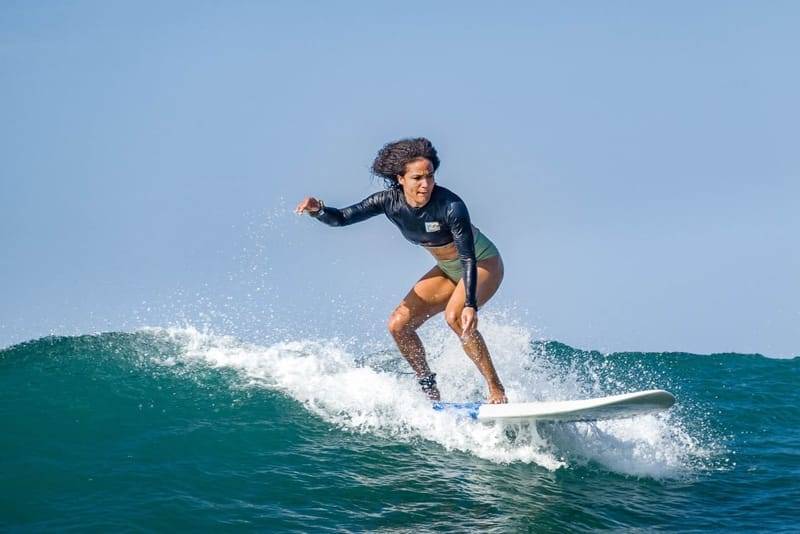
Most intermediate surfers treat every wave as a chance to try a turn rather than a chance to practise the fundamentals. Every wave you catch is a rep. The surfer who takes off on twelve small, unspectacular waves and practises a clean pop-up and a proper bottom turn on each of them will progress faster than the surfer who waits forty minutes for the set of the day and falls on the take-off.
Three things help. Sit where the waves are actually breaking, not where it feels safe, which is usually slightly too far outside. Start paddling earlier than feels necessary, and commit: three or four extra hard strokes at the end make the difference between catching the wave and watching it pass underneath you. And do not be too proud to take smaller waves.
Why Weligama is a good place to do all of this
Weligama Bay is a long, sandy-bottomed beach break that produces slow, forgiving waves from November to April and stays surfable right through the year. That matters for improvement. A soft, predictable wave gives you the repetitions that a hollow reef break does not, and a sand bottom means the consequence of a mistake is a wipeout rather than an injury. When you are ready for more, the reef breaks at Mirissa, Midigama and Ahangama are a short tuk-tuk ride away.
Our surf lessons in Weligama run twice a day and are grouped by ability, so an intermediate surfer works on exactly the things above with an ISA-certified instructor. Video analysis, surf theory and daily yoga are included in every weekly package. If you have been stuck at the same level for a season or two, a focused week is usually what breaks the plateau.
Written by The Surfer Surf Camps Team
Surf camp operators, Weligama, Sri Lanka
The team running three surf camps on Weligama Bay in southern Sri Lanka, in the water on this coast every day of the November-April season.
Ready to ride?
Book your surf experience with The Surfer